

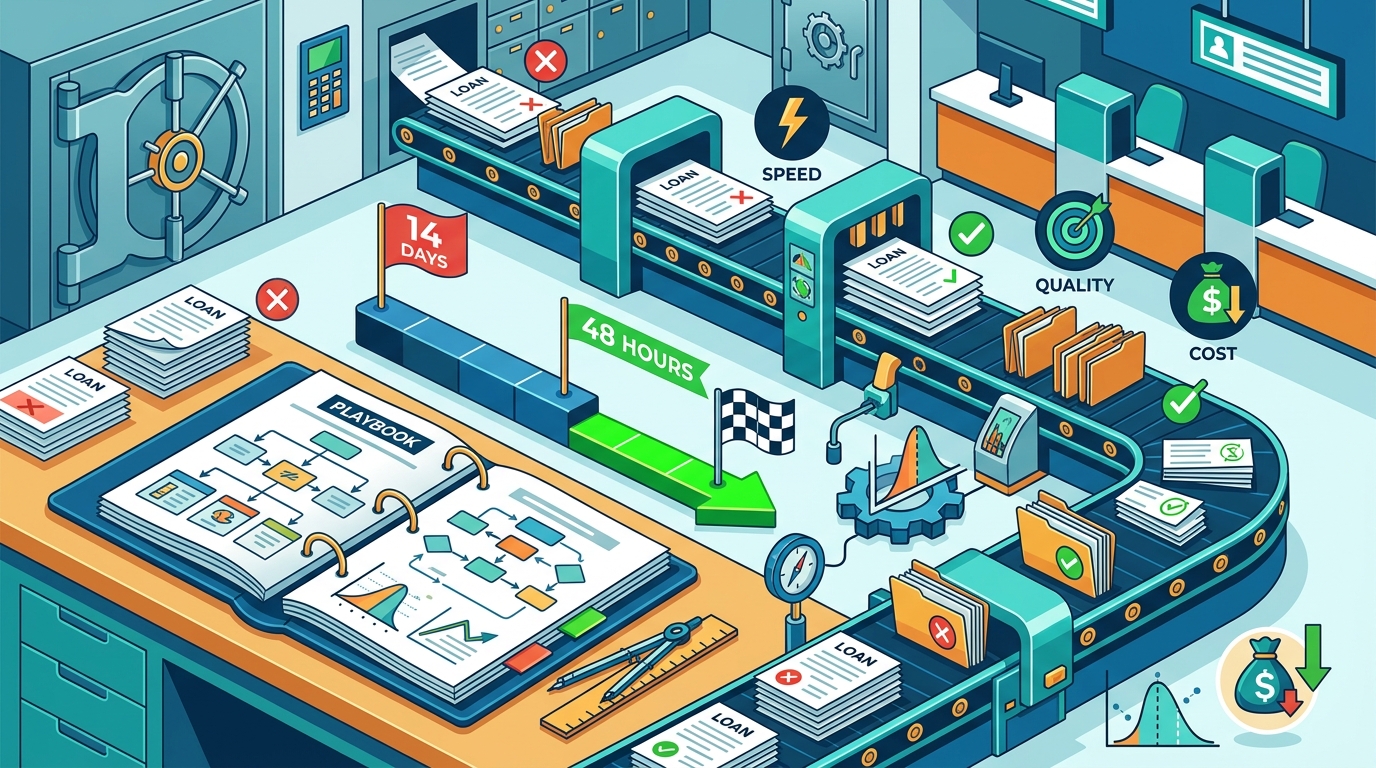
Banks today compete not just on interest rates or product range, but on how fast and accurately they deliver services. A loan approval that takes 14 days when a fintech rival does it in 48 hours is a competitive liability. Lean Six Sigma (LSS) offers a battle-tested methodology for closing that gap—combining Lean's focus on eliminating waste with Six Sigma's statistical rigor to drive measurable gains in speed, quality, and cost.
This playbook walks operations leaders through a practical, phase-by-phase approach to running an LSS initiative inside a bank. Rather than rehashing textbook theory, it emphasises real decisions you will face, tools that matter most in financial services, and pitfalls that derail banking-specific projects.
Why Lean Six Sigma Works Especially Well in Banking
Banking processes—loan origination, payment processing, KYC onboarding, cheque clearance—are repetitive, data-rich, and customer-facing. That makes them ideal candidates for LSS. As one industry study noted, the banking industry has been extensively researched for implementing Six Sigma methodologies because they are known for increasing process efficiency, reducing errors, and improving customer satisfaction.
Major institutions have proven the concept at scale. Bank of America launched its Six Sigma programme in 2001, ultimately certifying over 10,000 employees as Champions, Master Black Belts, Black Belts, and Green Belts. The results included a 70% reduction in customer statement errors, an 88% drop in electronic-channel defects, and mortgage cycle times cut by 15 days. JPMorgan Chase, Citigroup, American Express, and HSBC have followed similar paths.
Pre-Launch: Building the Foundation Before You Start
Many LSS banking projects fail before the first data point is collected. The pre-launch phase is where you set the conditions for success.
1. Secure Genuine Executive Sponsorship
Research consistently identifies senior management commitment and organisational culture as critical variables for implementing Six Sigma in banking. At Bank of America, CEO Ken Lewis personally completed a Green Belt project—a signal that quality was not a passing initiative. Your sponsor should chair the steering committee, remove resource blockers, and tie project outcomes to business KPIs visible at board level.
2. Select the Right Pilot Process
Do not start with the most politically sensitive process. Instead, pick one that is high-volume, has visible pain (customer complaints, rework, long cycle times), and produces quantifiable data. Common banking pilot candidates include:
- Business loan turnaround time
- Payment-processing error rates
- Account-opening cycle time
- KYC document handling and onboarding
- Fraud-investigation false-positive rates
3. Assemble a Cross-Functional Team
Banking operations sit at the intersection of compliance, IT, risk, and customer service. Your improvement team must include representatives from every function the process touches. Bank of America recruited Master Black Belts externally from organisations like Motorola and GE to accelerate early momentum, while developing internal talent through structured training programmes.
4. Establish Baseline Metrics and a Project Charter
Define what success looks like before you begin. Common banking metrics include defects per million opportunities (DPMO), process cycle efficiency (PCE), first-contact resolution rate, and cost per transaction. Capture these in a one-page project charter that documents the problem statement, scope boundaries, target improvement, timeline, and team roles.
Phase-by-Phase Execution Using DMAIC
The DMAIC cycle (Define, Measure, Analyse, Improve, Control) is the backbone of every LSS project. Below is how each phase plays out specifically inside banking operations.
Phase 1 — Define: Frame the Problem in Business Terms
Create a SIPOC diagram (Suppliers, Inputs, Process, Outputs, Customers) for your target process. In banking, this often reveals that the 'customer' is both the end borrower and an internal compliance team—dual customers whose requirements can conflict. Also capture the Voice of Customer (VOC) through complaint logs, survey data, and frontline interviews. One widely used LSS tool here is a Critical-to-Quality (CTQ) tree that translates broad customer needs (e.g., 'fast loan decisions') into measurable requirements (e.g., 'approval within 3 business days').
Phase 2 — Measure: Quantify the Current State
Collect data on the metrics defined in your charter. In a loan-processing project, this means timing each sub-step: application intake, document verification, credit assessment, underwriting, approval routing, and disbursement. One practitioner case found that actual credit assessment required only 6.2 hours out of a 14-day cycle—the remaining 13.8 days were pure waiting time. Without measurement, that insight stays hidden.
Use value-stream mapping to visualise where time, effort, and hand-offs accumulate. Build control charts to understand natural process variation versus special-cause spikes. Validate your measurement system (Measurement System Analysis) before drawing conclusions—banking data often sits in siloed core systems with inconsistent definitions.
Phase 3 — Analyse: Find Root Causes, Not Symptoms
This is where statistical thinking separates LSS from generic process improvement. Useful analysis tools for banking include:
- Ishikawa (fishbone) diagrams to brainstorm potential causes across categories like People, Process, Technology, and Regulation.
- Pareto analysis to identify the vital few causes. In one payment-processing case, 72% of errors fell into just three categories: incorrect beneficiary entry, amount transposition, and incomplete reference data.
- Regression and hypothesis testing to confirm which variables truly drive defects or delays.
- Process Cycle Efficiency (PCE) to quantify value-added versus non-value-added time.
Banking-specific insight: always map regulatory and compliance requirements as constraints, not waste. Eliminating a compliance step that looks 'non-value-added' can create far bigger problems than the inefficiency it removes.
Phase 4 — Improve: Design and Pilot Solutions
Generate solutions that address confirmed root causes. In banking, effective improvements often include:
- Risk-based routing: Only escalate high-risk applications through all approval stages; auto-approve or fast-track routine ones.
- Continuous flow over batch processing: Replace daily batch runs with real-time processing queues to collapse waiting time.
- Poka-yoke (error-proofing): Add field-level validation in digital forms to prevent data-entry errors at the source.
- Standard work instructions: Document best-practice procedures so performance does not vary by shift or branch.
- Automation of non-judgement tasks: Use RPA or workflow engines for document routing, status notifications, and data extraction.
Pilot improvements in a single branch or team before enterprise rollout. A Palestinian bank piloted LSS improvements to its account-opening process at one branch and reduced average time from 38 minutes to 14.7 minutes—a 61.4% reduction—before scaling the new standard across the network.
Phase 5 — Control: Lock In Gains and Prevent Regression
The Control phase is where most banking projects quietly unravel. Without sustained attention, old habits return within months. Effective control mechanisms include:
- Statistical process control (SPC) charts monitored weekly by process owners—not project teams.
- Updated standard operating procedures (SOPs) embedded in workflow systems, not filed in binders.
- Dashboards visible to leadership that track DPMO, cycle time, and cost per transaction in near-real time.
- Periodic audits conducted quarterly to verify adherence.
- Formal hand-off from the project team to line management, with documented escalation triggers.
Integrating AI Into Your LSS Programme
The newest evolution in banking process excellence is combining LSS with artificial intelligence. AI does not replace the disciplined structure of DMAIC—it amplifies it. Emerging use cases include using process mining and AI to map end-to-end KYC workflows and identify redundant checks, applying NLP to analyse customer conversations and feed insights into DMAIC projects, and leveraging AI-based anomaly detection alongside Lean waste-reduction frameworks to reduce fraud false positives.
Organisations pursuing this path should start with data readiness—ensuring process data is accurate, accessible, and integrated—before embedding AI tools into specific DMAIC phases.
Common Pitfalls in Banking LSS Implementations
- Treating LSS as an IT project. Technology enables improvements; it does not cause them. The root-cause analysis and cultural change work must come first.
- Ignoring change management. Many practitioners lack change management competency—the ability to manage the people side of change. Build a communication plan and stakeholder engagement strategy from day one.
- Over-scoping the first project. A narrowly defined pilot that delivers measurable results in 90 days builds more organisational credibility than a sprawling initiative that takes a year.
- Confusing compliance steps with waste. Regulatory requirements are constraints to design around, not non-value-added activities to eliminate.
- Failing to transition ownership. If the Black Belt leaves and the process reverts, you have not improved anything—you ran an expensive experiment.
Key Takeaways
- Lean Six Sigma is uniquely suited to banking because the sector's processes are repetitive, data-rich, and directly impact customer satisfaction.
- Executive sponsorship is non-negotiable—research and real-world cases both confirm it is the single biggest predictor of programme success.
- Use DMAIC as your execution framework, but invest heavily in the pre-launch phase: right pilot, right team, right metrics.
- Measure before you assume. Huge cycle-time gains often come from eliminating waiting time, not speeding up the actual work.
- The Control phase is where value is preserved. Embed improvements into systems and standard work, not slide decks.
- AI is an accelerator, not a replacement, for LSS discipline in modern banking operations.
Frequently Asked Questions
What banking processes benefit most from Lean Six Sigma?
High-volume, repetitive processes with measurable outputs benefit most. Loan origination, payment processing, account opening, KYC onboarding, and fraud investigation are the most common starting points. These processes generate abundant data and have clear quality metrics like error rates, cycle times, and customer complaint volumes.
How long does a typical Lean Six Sigma banking project take?
A well-scoped DMAIC project typically runs 12 to 16 weeks from charter approval to Control-phase hand-off. Enterprise-wide deployment—including training waves and multiple project cycles—usually spans 18 to 36 months. Starting with a focused 90-day pilot builds credibility for broader rollout.
Do we need Black Belt certification to start?
Not necessarily for your first project, but having at least one trained Black Belt or experienced external consultant significantly increases the odds of success. Bank of America initially recruited experienced practitioners from companies like Motorola and GE while building internal capability through Green Belt and Black Belt training programmes that eventually certified over 10,000 employees.
How does Lean Six Sigma differ from general process improvement in banking?
General process improvement often relies on brainstorming and best guesses. Lean Six Sigma adds statistical rigour—using data to prove which root causes actually drive defects and delays, and control charts to verify that improvements hold over time. This evidence-based approach is particularly valuable in regulated banking environments where changes must be justified and auditable.
Can Lean Six Sigma and AI work together in banking?
Yes, and this combination is increasingly common. AI enhances DMAIC by automating data collection in the Measure phase, using machine learning for root-cause analysis, and enabling predictive control charts. Lean Six Sigma provides the structured discipline that prevents AI initiatives from becoming unfocused technology experiments. Together they enable what experts call process intelligence rather than just process improvement.