

Community and small banks face the same sophisticated cyber adversaries as global institutions—but with a fraction of the budget and staff. This ultimate guide maps out the modern threat landscape, regulatory expectations, and practical steps small banks can take right now to build genuine cyber resilience.
The 2025-2026 Threat Landscape for Small Banks
The cybersecurity terrain facing financial institutions has shifted dramatically. Ransomware appeared in 44 percent of breaches overall, and for small and midsize organizations the picture is even grimmer—88 percent of SMB breaches involved ransomware. Alongside ransomware, AI-powered attacks are surging; 16 percent of breaches now involve AI-driven techniques including phishing and deepfake impersonation, according to IBM's Cost of a Data Breach Report 2025.
The Federal Reserve System reports that the top threats currently impacting the financial sector are ransomware, phishing, external-facing application vulnerabilities, system misconfigurations, and DDoS attacks. Email remains the largest channel for cyberattacks, with phishing and business email compromise serving as the entry point for most incidents.
Looking forward, experts forecast that the greatest impact on financial-sector cybersecurity in 2025-2026 will come from the exploitation of API vulnerabilities and supply chain attacks. Meanwhile, attackers increasingly use AI to personalize scams, evade detection, and automate credential theft—making traditional fraud defenses less effective.
Why Small Banks Are Disproportionately Targeted
In a 2024 survey from the Conference of State Bank Supervisors, community bankers identified cybersecurity as the greatest internal risk to their operations. Federal Reserve Vice Chair for Supervision Michelle Bowman has acknowledged that maintaining the necessary resources and technology for a successful cybersecurity program can feel especially challenging and financially burdensome for community banks.
Smaller institutions typically have one or two IT staff members handling everything from desktop support to security monitoring. They share the same regulatory obligations as larger banks but lack dedicated security operations centers, threat intelligence teams, and the buying power for enterprise-grade tools. This resource gap creates an asymmetry that attackers actively exploit—they know a community bank with $500 million in assets is less likely to have 24/7 network monitoring than a money-center bank.
Regulatory Frameworks and the Post-CAT Era
Cybersecurity is now a regulatory expectation, not just a best practice. Financial institutions must demonstrate operational resilience and tested incident response capabilities under frameworks such as FFIEC guidance and the GLBA Safeguards Rule.
A major transition occurred when the FFIEC Cybersecurity Assessment Tool (CAT) was sunset on August 31, 2025. The FFIEC indicated that supervised institutions may consider several government and industry-developed tools to manage their cybersecurity programs going forward. The primary replacements include:
- NIST Cybersecurity Framework 2.0 — Provides outcome-based recommendations for managing cybersecurity risks without prescribing specific tools.
- CISA Cross-Sector Cybersecurity Performance Goals (CPGs) — A prioritized, simplified set of cybersecurity practices aligned with NIST CSF 2.0, designed to help small and medium-sized organizations prioritize investments.
- Cyber Risk Institute (CRI) Cyber Profile — Developed collaboratively by financial institutions and trade associations to promote a global standard for banks' cyber risk assessments. Its continuously updated diagnostic statements reflect the dynamic nature of cyber threats.
- CIS Critical Security Controls — 18 overarching measures that can map to NIST, ISO, and other regulatory frameworks.
Small banks should not wait to transition. Selecting a replacement framework now and mapping existing controls to it will prevent a gap in your compliance posture during examinations.
Strengthening Identity and Access Controls
Almost all cloud breaches stem from misconfiguration and inadequate identity controls. For small banks, this means that getting identity management right is arguably the single highest-return cybersecurity investment available.
Practical Steps
- Enforce MFA everywhere. Multifactor authentication should cover not just customer-facing portals but all administrative access, VPN connections, email accounts, and third-party SaaS platforms.
- Implement least-privilege access. Employees, contractors, and vendors with excessive access rights can unintentionally or intentionally cause security incidents. Conduct quarterly access reviews and revoke dormant accounts immediately.
- Deploy privileged access management (PAM). For a small bank, a cloud-hosted PAM solution can secure admin credentials, rotate passwords automatically, and log all privileged sessions for audit.
- Adopt Zero Trust principles. Verify every session, every device, and every user—regardless of whether they are inside the network perimeter.
Ransomware Readiness
Throughout 2025 and 2026, ransomware will remain a primary type of malware used by cybercriminals targeting financial institutions. Experts expect an increase in attacks involving data encryption and destruction targeting small and medium-sized companies with connections to the financial sector.
Modern ransomware goes beyond encrypting files—attackers now steal data and pressure banks into paying by threatening public leaks. Ransomware groups in 2026 are likely to focus on critical systems such as payment gateways and customer databases.
A Five-Layer Ransomware Defense
- Immutable backups. Store backups offline or in write-once storage. Test restoration quarterly—an untested backup is not a backup.
- Endpoint detection and response (EDR). Traditional antivirus is insufficient. EDR solutions detect behavioral anomalies and can isolate compromised endpoints in real time.
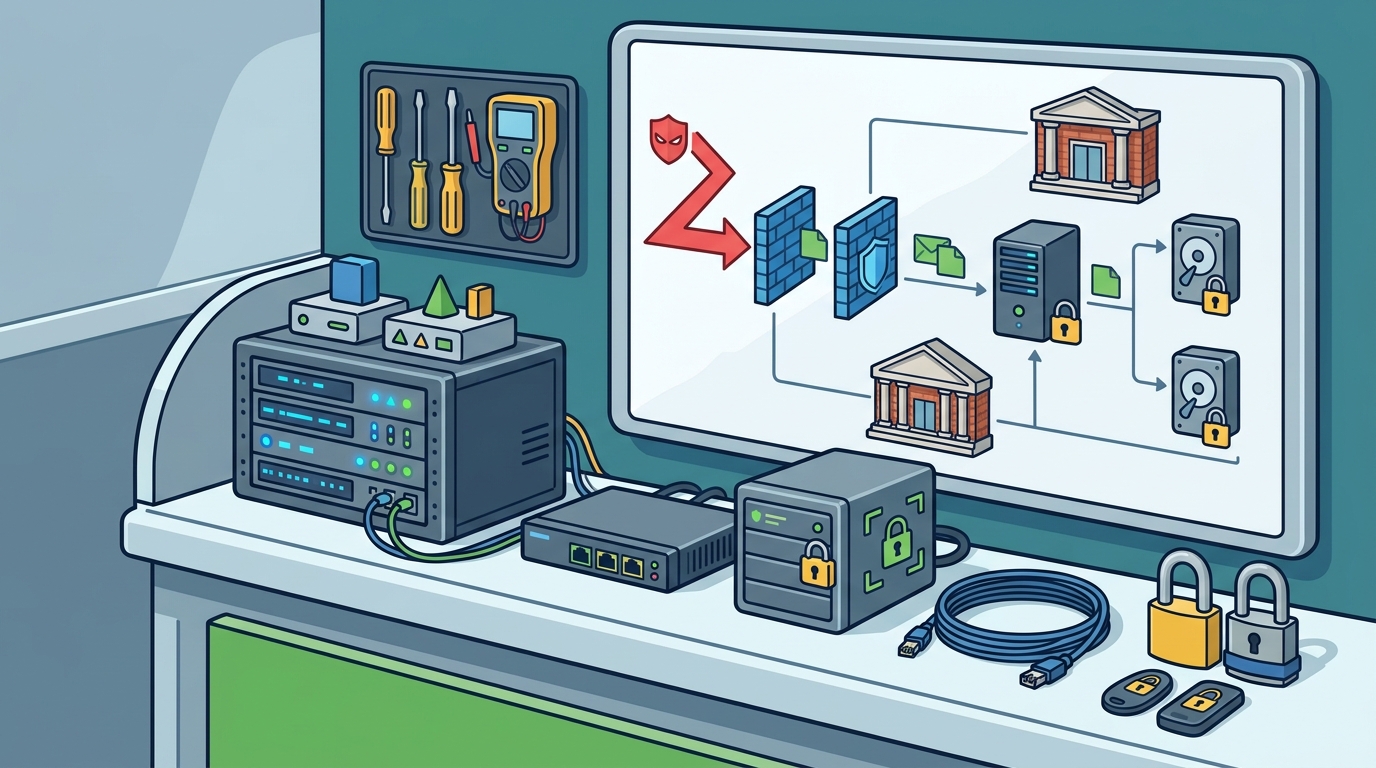
- Network segmentation. Separate core banking systems from general office networks so that a compromised workstation cannot reach the loan origination server.
- Email gateway filtering. Since email is the largest channel for cyberattacks, advanced email security with link detonation and attachment sandboxing is essential.
- Tabletop exercises. Walk through a ransomware scenario at least twice a year with decision-makers, IT, legal, and communications staff.
Third-Party and Supply-Chain Risk Management
Banks rely on a growing ecosystem of vendors and fintech partners, and each integration introduces potential vulnerabilities. A single vendor compromise can have widespread impact—as demonstrated by multiple high-profile breaches in 2025 that exploited vulnerabilities in third-party software providers used by several banks.
Vendor Risk Program Essentials
- Due diligence before onboarding. Request SOC 2 Type II reports, penetration test results, and business continuity plans before signing any contract.
- Contractual security requirements. Third-party vendors need contractual robust cybersecurity standards under Bank Service Company Act authorities. Include right-to-audit clauses and breach notification timeframes (ideally 24-48 hours).
- Ongoing monitoring. Perform ongoing due diligence and regular assessments of vendor security practices, including fourth-party vendors. Use external attack surface monitoring tools that flag changes to your vendors' exposed infrastructure.
- Concentration risk analysis. Map which vendors your other vendors depend on. If three critical service providers all run on the same cloud platform, a single outage could cascade across your operations.
Employee Training That Actually Works
The biggest cybersecurity threat remains human error—people who have been tricked into providing sensitive details, haven't properly protected passwords, or have clicked on malicious links. Annual awareness sessions are not enough; banks need continuous, role-based security education that reflects real attack scenarios.
Building a Security-Aware Culture
- Phishing simulations monthly. Use platforms that send realistic test phishing emails and track click rates. Reward improvement rather than punishing failure.
- Role-specific modules. Teller staff need training on social engineering at the window; wire transfer teams need training on business email compromise; executives need deepfake awareness, since executives and finance teams are especially high-value targets due to access to sensitive systems.
- Just-in-time nudges. Deploy browser plugins or email banners that warn users in real time when they encounter suspicious links or external sender impersonation.
- Board-level reporting. Present phishing simulation metrics, incident trends, and training completion rates to the board quarterly. This reinforces that cybersecurity is a business-critical function tied directly to trust, revenue, and compliance.
Cloud Security Hygiene
With banking operations increasingly migrating to the cloud, robust encryption, multifactor authentication, and regular audits have become more essential than ever. Yet 99 percent of cloud security failures are attributed to the customer, not the provider.
Cloud Hardening Checklist for Small Banks
- Enable logging on all cloud services and centralize logs in a SIEM or managed detection platform.
- Use cloud security posture management (CSPM) tools to detect misconfigurations automatically.
- Encrypt data at rest and in transit with bank-managed keys where possible.
- Develop a comprehensive cloud security strategy that includes both technology solutions and regular audits to maintain compliance.
- Restrict administrative access to cloud consoles with hardware security keys (FIDO2).
- Maintain consistent security policies across SaaS, PaaS, and IaaS environments.
Building a Tested Incident Response Plan
Having a plan on paper is meaningless if no one has practiced it. An incident response plan should include procedures for detecting, reporting, responding to, and recovering from security incidents. Test the plan regularly through simulations and drills.
Core Components
- Detection triggers. Define what constitutes an incident versus an event. Examples: anomalous wire transfer over $50,000, EDR quarantine alert, or vendor reporting a breach.
- Escalation matrix. Who calls whom, in what order, at 2 a.m.? Include cell phone numbers, not just office extensions.
- Regulatory notification. Banks should promptly notify their primary federal regulator of a security breach involving sensitive customer information. Under the 2022 Computer-Security Incident Notification Rule, banking organizations must notify their primary regulator within 36 hours of determining a qualifying incident has occurred.
- Forensic preservation. Designate in advance whether you will use an in-house capability or a retainer with a digital forensics firm. Engaging a forensics partner before an incident is far cheaper than scrambling during one.
- Restoration. Follow FFIEC Information Security IT Booklet guidance: eliminate the attacker's means of access, restore systems to their previous working state, and monitor for similar or related incidents.
- Post-incident review. Conduct a blameless retrospective within 14 days. Update the plan based on lessons learned.
Cybersecurity as a Service for Lean Teams
Outsourcing certain aspects of cybersecurity—such as threat detection, vulnerability management, and incident response—is becoming more common, especially among smaller banks and credit unions that may lack the resources for a fully in-house security team. This shift allows financial organizations to leverage the expertise and advanced tools of cybersecurity providers while reducing costs and operational complexity.
What to Outsource vs. Keep In-House
| Function | Outsource Candidate? | Notes |
|---|---|---|
| 24/7 SOC monitoring | Yes | Virtual SOC (vSOC) services provide round-the-clock coverage at a fraction of in-house cost. |
| Penetration testing | Yes | Annual external pen tests plus quarterly internal scans. Use independent firms, not your managed service provider. |
| Vulnerability management | Yes | Managed vulnerability scanning with prioritized remediation guidance. |
| Policy and governance | Partial | A virtual CISO (vCISO) can draft policies and present to the board, but internal ownership of risk decisions is essential. |
| Incident response | Hybrid | Pre-negotiate a retainer with an IR firm; keep first-responder triage skills in-house. |
| Security awareness training | Yes | Use SaaS training platforms; customize content for banking-specific scenarios. |
Using AI for Defense—Not Just Attackers
AI is now a core component of modern cybersecurity strategies in banking. While attackers use AI to craft highly convincing phishing emails, deepfake voice calls, and automated credential theft, defenders can turn the same technology around:
- Behavioral analytics. AI models baseline normal user and entity behavior, then flag deviations—such as a teller account querying 500 customer records at midnight.
- Real-time fraud analytics. Machine learning models score transactions in milliseconds, catching anomalous patterns that rule-based systems miss.
- Automated threat intelligence correlation. AI can ingest feeds from FS-ISAC, CISA, and commercial sources, then correlate indicators of compromise against your environment automatically.
- AI guardrails. If your bank deploys any customer-facing AI (chatbots, robo-advisors), embed security guardrails directly into those platforms to prevent prompt injection and data leakage.
However, underestimating the risks associated with AI implementation and the lack of oversight of AI operation could lead to a decline in the security posture of financial organizations. Every AI tool should be inventoried, risk-assessed, and governed under your existing technology risk management framework.
Key Takeaways
- Small banks face the same adversaries as large institutions but with far fewer resources—making prioritization and smart outsourcing critical.
- Ransomware affects 88% of SMB breaches; immutable backups, EDR, and network segmentation are non-negotiable defenses.
- With the FFIEC CAT sunset, adopt NIST CSF 2.0 paired with CISA CPGs or the CRI Cyber Profile as your replacement assessment framework.
- Identity and access management failures cause the vast majority of cloud breaches—enforce MFA, least privilege, and Zero Trust.
- Third-party risk is existential; contractual controls, ongoing monitoring, and fourth-party visibility are essential.
- Employee training must be continuous, role-based, and measured—not an annual compliance checkbox.
- Cybersecurity as a Service (vSOC, vCISO, managed detection) allows lean teams to achieve enterprise-grade coverage.
- AI is a double-edged sword—deploy it for defense while governing its risks under your existing framework.
Frequently Asked Questions
What is the biggest cybersecurity threat to small banks in 2026?
Ransomware remains the dominant threat, appearing in 88% of SMB breaches. AI-enhanced phishing and supply chain attacks are close behind, with attackers using AI to personalize scams, evade detection, and automate credential theft.
What replaced the FFIEC Cybersecurity Assessment Tool (CAT)?
The FFIEC recommends several alternatives including the NIST Cybersecurity Framework 2.0, CISA Cross-Sector Cybersecurity Performance Goals, the Cyber Risk Institute (CRI) Cyber Profile, and the CIS Critical Security Controls. No single replacement is mandated; banks should choose frameworks that fit their size and complexity.
How can a small bank afford 24/7 cybersecurity monitoring?
Cybersecurity as a Service models—particularly virtual SOC (vSOC) services—provide round-the-clock monitoring at a fraction of the cost of building an in-house team. Outsourcing threat detection, vulnerability management, and incident response lets small banks leverage enterprise-grade tools and expertise.
How often should a small bank test its incident response plan?
At minimum, conduct tabletop exercises twice a year and a full simulation annually. The plan should include procedures for detecting, reporting, responding to, and recovering from security incidents, and should be updated after every real incident or significant infrastructure change.
What role does employee training play in bank cybersecurity?
Human error remains the biggest cybersecurity threat. Banks need continuous, role-based security education with monthly phishing simulations, just-in-time warnings, and board-level reporting on training effectiveness—not just an annual compliance session.
Should small banks use AI in their cybersecurity programs?
Yes—behavioral analytics, real-time fraud scoring, and automated threat intelligence correlation all benefit from AI. However, every AI tool must be inventoried, risk-assessed, and governed. Underestimating AI risks and lack of oversight could actually weaken a bank's security posture.